The Stories We Mistake for Ourselves
We explain ourselves after the fact, then mistake the explanation for truth. This piece looks at memory, bias, and the private stories that make our behaviour feel coherent — even when they keep us from seeing ourselves clearly.
Noor Arin
5/22/20264 min read
The Stories We Mistake for Ourselves
A person ignores a message for three days and calls it needing space. They cancel a plan at the last minute and call it being overwhelmed. They avoid a difficult conversation and call it keeping the peace. None of these explanations are necessarily false. That is what makes them useful.
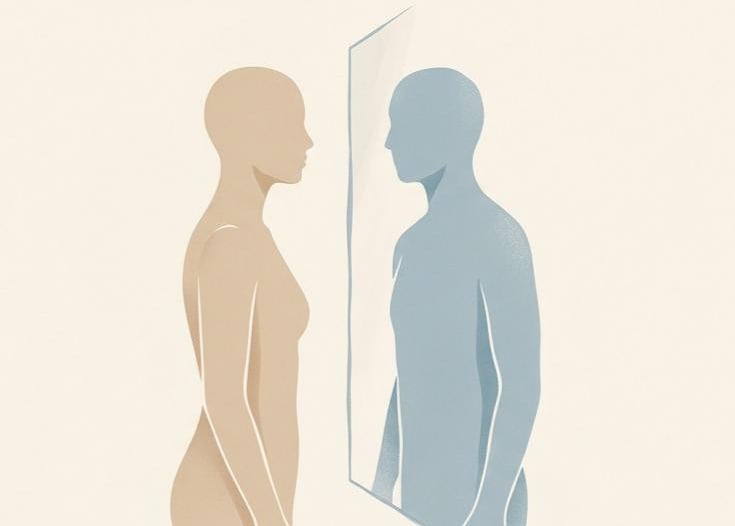
We rarely experience ourselves as confused. Most of the time, we move through life with a working theory of who we are: what frightens us, what we want, what we would never do, what we are “just like.” The theory feels private and intimate, which makes it seem accurate. But self-knowledge is not a clear window. It is closer to a story assembled under pressure, revised in memory, and defended because it helps the day hold together.
The mind is good at making behaviour feel coherent. It takes a reaction, a hesitation, a burst of anger, a silence, and gives it a reason. Sometimes the reason is honest. Sometimes it is partial. Sometimes it is only the nearest explanation that allows us to keep moving.
This is not hypocrisy in the dramatic sense. It is ordinary. A person who thinks of herself as honest may still avoid telling a friend that she feels hurt. She tells herself the timing is wrong, that the friend has enough going on, that saying something would make the situation heavier than it needs to be. Some of that may be true. But underneath it may be fear: fear of seeming needy, fear of being dismissed, fear of discovering that the friendship cannot carry discomfort. The story she chooses is not a lie exactly. It is a softer version of the truth.
Memory helps with this softening. We tend to treat memory as storage, as if the past sits somewhere intact, waiting to be retrieved. It does not. Memory is rebuilt each time it is touched. A sentence from years ago gathers new meaning. An awkward silence becomes rejection. A small failure becomes proof of a permanent flaw. The past does not simply return; it arrives edited.
That editing can harden into identity. Someone who once felt humiliated in a room full of confident people may later describe himself as “not ambitious,” when what he means is that ambition has come to feel unsafe. Someone who was repeatedly ignored may call herself independent, when part of that independence began as a way to stop expecting care. These identities can be intelligent adaptations. They may have protected us once. The trouble begins when protection starts calling itself personality.
Psychologists have a name for one part of this tendency: self-verification. We often prefer information that confirms what we already believe about ourselves, even when the belief is painful. A person convinced they are difficult to love may distrust affection, test it, withdraw from it, or choose people who keep love uncertain. When the relationship falters, the old belief returns with evidence in its hands.
The pattern can look like fate from the inside. It is not fate. It is repetition with a good memory.
Some of the clearest evidence for the mind’s storytelling comes from research on choice blindness. In landmark studies by psychologist Petter Johansson and his colleagues, people were asked to choose between two faces. In some trials, the researchers secretly switched the chosen image and handed back the one the participant had not selected. Many people failed to notice. More strikingly, they then explained why they had chosen it, describing preferences for features they had, moments earlier, rejected.
The point is not that people are foolish. The point is that explanation is often faster than awareness. The mind can produce reasons with remarkable confidence, even when the reasons are built after the fact.
Neuroscientist Michael Gazzaniga’s work with split-brain patients sharpened this idea. In some experiments, one side of the brain received information the speaking side could not access. When asked to explain an action, the speaking hemisphere still offered a reason. It filled the gap. It made a story. Gazzaniga called this capacity the “interpreter”: the part of the mind that tries to make experience feel continuous, even when the evidence is incomplete.
Most of us do not need a laboratory to recognise this. We know the small courtroom inside the head. We defend a tone we used. We explain why we did not call. We turn envy into moral judgment, disappointment into detachment, fear into principle. The explanation may be partly true. That is why it holds. But it rarely contains the whole truth.
This becomes especially visible in relationships, where self-misunderstanding does not stay private. If someone believes they are always overlooked, they may hear delay as rejection. If someone fears being too much, they may become careful, edited, half-present. If someone thinks they are calm because they rarely raise their voice, they may miss the quieter forms of control: withholding warmth, changing the subject, making another person feel unreasonable for wanting clarity.
The gap between self-image and behaviour is often widest around the qualities we value most. A person who values honesty may avoid directness. A person who values independence may secretly arrange life around approval. A person who values kindness may use kindness to avoid conflict. These contradictions are not proof of fraud. They are evidence that the self is less settled than its descriptions.
The harder part is that many misunderstandings are not accidental. We protect them because they protect something in us. To change a belief about yourself is not just to update a sentence. It can mean revisiting the experiences that made the sentence necessary. “I’m not good with people” may be easier to carry than “I learned to expect embarrassment.” “I don’t need anyone” may feel stronger than “needing people has not always been safe.”
Certainty has its comforts. A fixed identity narrows the field. It tells us what to avoid, what to expect, where not to hope. Even a painful self-image can become familiar enough to feel like shelter.
The work, then, is not to replace every old story with a brighter one. That would be another kind of performance. A more useful beginning is to become suspicious of sentences that sound too final. I always ruin things. I never speak up. I’m just not that kind of person. These lines may contain history, but they are not the whole record.
A better question is quieter: what am I protecting by believing this?
Self-knowledge may not be a destination we arrive at. It may be a practice of catching the story in motion, noticing where it edits, where it excuses, where it punishes, where it refuses new evidence. We do not need to distrust every thought we have about ourselves. But we might stop treating every familiar explanation as proof.
The person we are most certain about is often the one we have learned to question least. That certainty can feel like wisdom. Sometimes it is only habit, speaking in a steady voice.
Contact
For commissions, collaborations, or editorial enquiries, feel free to get in touch.
contact@noorarin.com
© 2026 Noor Arin. All rights reserved.