Before Desire Had a Name: What same-sex behaviour in animals reveals about nature’s older patterns
Same-sex behaviour appears across animal life — in dolphin alliances, bonobo social bonds, and albatross pairs raising chicks. This piece looks at what those patterns reveal when attraction is seen before language, before identity, and before the human need to name it.
Noor Arin
4/22/20264 min read
Attraction Before Language
Attraction did not begin with language. Long before humans learned to name desire, classify it, defend it, or argue over it, bodies were already moving toward one another. Animals formed bonds, touched, paired, competed, reconciled, and returned to familiar companions. Some of those relationships involved members of the same sex. They were not statements. They were not identities. They were behaviours, woven into ordinary life.
That distinction matters. In biology, researchers usually call it same-sex behaviour, a deliberately narrow phrase. It describes what can be observed without rushing to explain what it means. A dolphin does not announce an orientation. A bonobo does not build a theory of the self. An albatross does not turn pair-bonding into politics. The human habit is to name, interpret, and arrange experience into categories. Other animals leave us with something less tidy: repeated patterns, visible across species, that do not fit easily into reproduction alone.
In Shark Bay, Western Australia, male bottlenose dolphins form alliances that can last for years. The water there is shallow and bright, broken by seagrass banks and sand flats. Young males move together through it in pairs or small groups, learning one another’s signals, habits, and timing. Marine biologist Janet Mann has spent decades studying these dolphins, and her work shows that male alliances are not casual associations. They are part of the animal’s social machinery.
Within those bonds, same-sex sexual behaviour occurs. But to isolate the sexual act from the alliance would miss the larger structure. These relationships help males cooperate, defend access to females, coordinate movement, and survive inside a demanding social world. The intimacy is not an ornament added to life. It sits inside the system itself.
In bonobo groups, the same pattern appears under different pressure. Their societies depend on contact, negotiation, and the quick repair of tension. Sex is not confined to mating. It appears in greetings, reconciliation, alliance-building, and the daily work of keeping a group from splintering. Frans de Waal described bonobo social life as unusually dependent on contact, with female same-sex interactions helping form bonds and ease conflict.
There is nothing sentimental about this. The behaviour is practical. It lowers pressure. It keeps relationships workable. It helps the group continue. Seen up close, the boundary between sex and social life becomes less clean than human categories often suggest.
The Laysan albatrosses of Hawaii offer a quieter version of the same problem. Their lives unfold slowly: nesting sites, weather, long absences over the ocean, the shared labour of raising chicks. In a 2008 study, researchers Lindsay Young and Eric VanderWerf found a significant number of female-female pairs among Laysan albatrosses. These pairs were stable. They built nests, incubated eggs, and raised young.
No grand explanation is needed to make the observation interesting. The fact itself is enough. A pair bond existed. It endured. It worked within the conditions available to the birds.
For a long time, popular accounts of animal behaviour treated reproduction as the master key. If a behaviour did not lead directly to offspring, it was framed as a puzzle, a mistake, or an evolutionary side note. That view looks thinner now. Social species do not survive by mating alone. They survive through alliances, reduced aggression, shared care, rank, memory, and trust. A behaviour can matter because it keeps a group workable, lowers conflict, or strengthens bonds that later shape access to food, protection, or reproduction. Survival is often less direct than the old diagrams made it look.
Bruce Bagemihl’s Biological Exuberance gathered evidence of same-sex behaviour in hundreds of species, not to claim that animals are human in miniature, but to show how much variation exists once observers stop filtering nature through a narrow expectation. Joan Roughgarden’s Evolution’s Rainbow made a related argument: animal life is full of social arrangements that exceed simple competition and reproduction.
The caution is important. Human attraction is not the same as animal behaviour. People live inside language. We inherit categories, resist them, reshape them, and build identities through them. A person’s understanding of desire carries memory, culture, fear, pleasure, politics, and self-recognition. None of that can be projected cleanly onto a dolphin, a bonobo, or an albatross.
But the opposite mistake is just as limiting. To refuse the evidence because it unsettles human assumptions is not scientific caution. It is discomfort dressed as restraint.
What these animals show is not a simple answer to a human question. They show that variation is older than our vocabulary for it. They show that social life has always been messier than the diagrams made to explain it. Across species, same-sex behaviour appears in courtship, bonding, alliance, parenting, play, and conflict management. Sometimes it is brief. Sometimes it lasts years. Sometimes it helps hold a group together.
That does not make human attraction less complex. If anything, it removes the false simplicity around it. Desire is not merely an idea people invented after language. Nor is it only a reproductive mechanism with decorative feelings attached. It belongs to a wider field of attachment, contact, cooperation, and recognition.
The question, then, is not whether nature “proves” anything about human identity. Nature is not a courtroom, handing down verdicts for our arguments. What it offers is stranger and more useful: evidence that life has never been as narrow as the categories built around it.
Attraction may be something humans name. But the movement toward another body, the formation of bonds, the pull of contact and companionship — those came first.
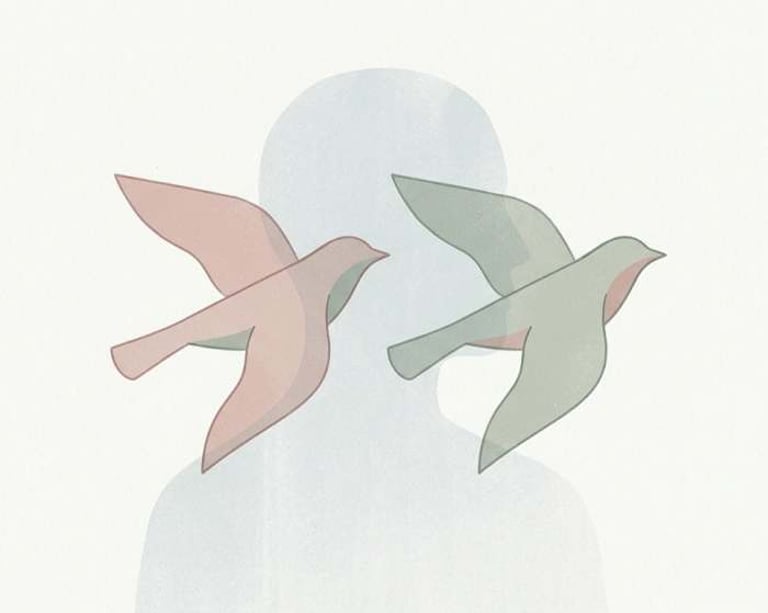
Exploring behavioural patterns across species through a minimal visual metaphor.
Contact
For commissions, collaborations, or editorial enquiries, feel free to get in touch.
contact@noorarin.com
© 2026 Noor Arin. All rights reserved.